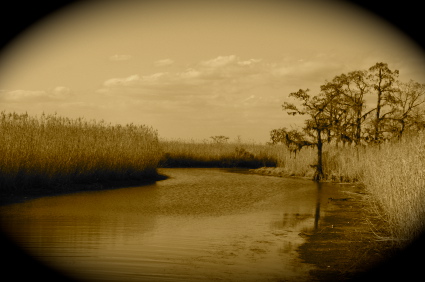
The hiss of gas escaping into the space heater announces that the old man has risen; soon the two-room houseboat will be tolerably warm. The man in the top bunk in the other room does not stir although he hears, knows, the signals–the unspoken command to rise and begin the day’s activities. He has been awake for some time because he has never slept well here; it is too quiet through the long night and he is too cognizant of the other, too careful of disturbing him with the creak of bedsprings. Though he is awake he does not rise, does not stir, remains in the warmth of the down sleeping bag and turns his head to the window. Outside the frost-dimmed pane, the black bayou shimmers with blanched half-moonlight filtered through willows that shiver silently on the dark mud bank.
He thinks: It is peaceful here–out there. It is the tranquility I come for, that I like about this place, and that is what I must focus on. But it is already too late. Already his thoughts have turned to this: I should have been the one to get up, to light the heaters and stove, to make the coffee. He is old now and I am grown and I should be taking care of him. Thinking: But that is not the natural order of things in this camp, and when one disturbs the natural order of things it’s hard to know what will result.
He checks the luminous dial of his watch. It is 3:55. He thinks: That’s early even by camp standards. The blind we’ll hunt today is only twenty minutes away and sunrise is at 6:43; legal shooting starts a half-hour before that. He must have had a bad night. His stomach, his back, his bones, his thoughts, something or everything conspired in his age-haunted body to prevent rest. If he can’t rest, why should I? That’s why he bangs the skillets and pans so noisily as he prepares for breakfast. It is my summons, my subpoena to appear in the other room and make myself useful. It does not matter that it is a full two hours before it will be time to leave. But I will not move. I will pretend I’m still sleeping and even that will be a victory of sorts, a statement to him that I refuse to be bullied. I am not yet ready to receive orders this morning.
It’s been three years since the younger man lay in this bunk, and it may be the last time he ever will. Every new direction in his life takes him farther from this place and makes it harder to return. The old man cannot have many seasons left in him and there may soon be nothing left to return to anyway. Until only the last few years he has been unbending, unscathed by passing winters but now he is showing signs of weakening and he cannot have many seasons left in him. It is too hard on a man, too strong the grip of cold that reaches into the bones of old men on days like this to shake their mortality; too much physical strength is needed to break with mudboat and pushpole the trails choked with matted water hyacinth and mud, to walk the gumlike marsh bottom in search of wounded prey. The marsh tests a man’s resolve, his desire weighed against the threshold for self-inflicted discomfort until that autumn evening when lying in his bed in the dark he grudgingly–and perhaps with great relief–admits to himself, “It is enough. I am not willing. This year I will not go.” And that day comes for every man, must come, even for him.
He, the son, knows that day must come but he cannot imagine it. In his mind the old man’s surrender to the inescapable force of time exists only as an abstract notion, mentally assented to but impossible to believe. To him, his father is what he has always been: competent, stubborn, immutable.
The thick brown smell of last night’s gumbo still permeates the air of the houseboat, clings to the fabric of the sleeping bag, penetrates the senses of the man. In that mysterious firing of millions of synapses the scent becomes one with a memory and that memory becomes as real as the odor in his nostrils. It is not the tranquility here that he has come for. It is this memory that ties him to this place, that bring him back–infrequently but inevitably–to these surroundings, to him. He closes his eyes and allows the memory to absorb him. He thinks about the meat run and he smiles.
There are a few perfect moments in every person’s life. The astute man, even in childhood, recognizes and captures these moments in mental snapshots to mount in the scrapbook of his imagination. These memories then become the things that sustain him when the world becomes too harsh. In the face of criticism and self-doubt he retreats, if he has the presence of mind to do so, to his album to find a part of himself he can admire. Preserved there are the game-winning shot, the big promotion, the birth of his child, some selfless act. Unlike photographs of paper and chemical that fade and yellow and report with brutal accuracy only what the unfeeling camera saw, these images grow sharper and larger with time and contain not just an image but an event. When they are plucked from the album they arouse the senses and replay the emotions that were a part of that event.
He is forty years old now and in all his memories he can find only one perfect moment snapshot that shows the two of them, his father and him, together. This disturbs but does not surprise him. For a memory to qualify as a perfect moment snapshot the owner of the remembrance must be in the foreground and shown in the best possible light. It has never been the practice of his father to stand in the background and even when he does he casts an enormous shadow. Still, he has that one picture, and now he pulls it out once more as he lies in the protective warmth of his bunk; he pulls it out once more to admire and draw strength from it before exposing himself to the coolness in the next room.
****
He was fifteen years old. By that time he had collected several snapshots. (Again there is the mysterious firing of synapses and a rush of images: the heavy feel of the “best defensive player” trophy from the eighth-grade basketball team, the echo of his name in the auditorium as he is declared winner of a state public speaking contest, his mother’s beaming face as he receives “Outstanding 4-H Boy” at the annual awards day.) He thinks: My mother was in nearly every photograph because to her everything I did was important and she shared vicariously the thrills of my triumphs, but my father was conspicuously absent. Perhaps he was aware–of course, he was aware–and he may have even acknowledged these accomplishments but I don’t remember that he did. I don’t remember that he did, and that makes it as though it did not happen. (This last he considers without anger, unaware of his own bitterness.) Thinks: That, again, is not surprising because, though we shared a house, my father and I lived separate lives and our paths converged only occasionally in a small houseboat deep in the Louisiana marshlands.
He made his first duck hunt with his father when he was ten years old, and every season thereafter until he left for college found him on any given non-school morning hunkered in the bottom of a two-and-a-half by five-foot iron tank with his twenty-gauge shotgun. “If duck hunting were a form of employment,” he once observed to his wife, “you could not pay enough to interest a man to rise before dawn, ride in an open boat through freezing wind, and sit in a cold metal tank surrounded by cold gray water for hours with drops of dew or rain dripping from his cap through his collar and running down his back, sitting in hopes of shooting a two-pound bird he would than have to pluck and singe and gut. But sportsmen are a strange lot and I’ll confess that at times I enjoyed it. Never, though, with the passion of my father.”
His father is (was, and ever shall be–even on that terrible unimaginable future day when he surrenders to the “enough”) a Duck Hunter. He once sought to explain this appellation to his wife:
Even though he has spent his entire adult life in the practice of law, and much of that time as a judge, I suspect his profession served primarily as a meant to support his true calling. Each summer near the middle of August preparations began for the two most important months of the year. Department stores divide November and December into Thanksgiving and Christmas; in our home these were better known as the first and second splits of the duck season. There were mudboats to repair, tank blinds to sink, runs to cut through the marsh, and decoys to patch. I participated in the autumn ritual not just because I was expected to do so but because it was a way to be with my father. I remember as a young boy telling my mother–I was crying at the time, I remember that–“He never does anything with me,” and she defended him by saying, “He takes you hunting,” and I said, “That’s because he wants to go.”
Lying there in his bunk with the smell of gumbo in his nostrils and gripped by his desire to recapture something so precious, so distant and unattainable, synapses exploding, he remembers. If he were to tell it (for he never has told it–not quite, not completely) this is what he would say, because this is what he has come to believe really happened that day:
I was fifteen years old. Dad and I had gone to the marsh, just the two of us, to get in one last late-season hunt. We arrived in the late afternoon, unloaded the supplies from the big boat, and began putting away the groceries. As we finished and I moved to stow our hunting gear, I noticed Dad double-checking the refrigerator and the empty paper sacks. He did not swear–I never recall hearing him swear until I was well into adulthood–but the frustration in his voice was obvious when he said, “We forgot the steaks.”
I was silently thankful that he was the one who had packed the food. He would not, of course, admit that it was his error–admission of a mistake was another thing I cannot recall escaping his lips, ever–but the fact that he had prepared the ice chest left him with no opportunity to upbraid me. We would return to town after the morning hunt, so tonight’s supper was the only meal we had planned. We had onions, rice, flour, and seasonings and nothing that could be substituted for a main course. For the uninitiated this may seem a rather small thing and one might think that a bowl of rice, a slice of bread, and a glass of milk is all a person really needs to survive one night in the wild. But any real hunter knows that the camp meal is just as important as the morning shooting, and a camp meal is nothing without meat for the pot.
Dad stepped onto the porch of the houseboat, studied the reddening western sky, and said, “We’d better make a meat run.”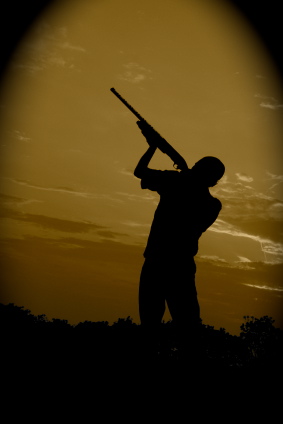
We pulled on our rubber chest waders, picked up our guns, and walked out to the mudboat shack. I hesitated a moment, not sure just what was expected of me, then Dad said, “I’ll drive, you shoot,” and I took my place in front of the engine. As Dad cranked the old Onan motor and headed us out of the bayou into the marsh I fully realized the nature of our expedition. The sun would be setting within the next half-hour; there was no time to drive out to one of the blinds to try for some legitimate shooting. Instead, we would take a more direct and desperate approach.
My job was to sit, gun ready, and to shoot any duck we might be lucky enough to jump within shotgun range as we raced down the trail. Even though our limited choice of assignments made me the shooter by default–Dad would never have trusted me to drive the boat–I felt good that he had enough confidence in me to at least allow me the chance to fail. I also felt a greater weight of responsibility than I could remember having up to that time. My stomach began to tie itself into tiny half-hitches.
A mudboat is long and narrow and flat-bottomed with a large air-cooled engine, generally about twenty-five horses, mounted in the center. It is designed to run in places with even a minimal amount of water and to chew through the soupy mixture of mud and water lilies and hyacinths that often chokes the runs where the boat must travel. The driver stands behind the engine and steers with a joystick linked to a small rudder; forward turns left, backward turns right. There is no reverse and there are no brakes.
The runs that cut through the low sawgrass plains and floating turf of coastal Louisiana form a maze of narrow trails that only a trained eye can follow. The flat, redundant water-prairie can confuse and mystify even in daytime, but at five-thirty in the morning when the only light is a glint of moonbeam off the water ahead even a veteran hunter can get lost in a moment of carelessness. Some leaseholders place sticks or flags at certain intersections to mark the way to their blinds, and misreading a signpost can mean finding yourself far from where you thought you were, and a lot of wasted time.
A mudboat ride through the marsh is, for the passenger, an exercise in child-like faith. The trail twists and turns, and only a short stretch of the run ahead is visible at any point, so the driver must know the run well and anticipate the turns as the boat flies through the grass or he will wind up beached on the mud bank. The passenger sits directly in front of the roaring, clattering engine, head ducked into the collar of his hunting coat, cap pulled low to block the freezing wind, and entrusts his safe arrival completely to the control of the driver. Sometimes it helps to close your eyes.
On the evening of the meat run there was no closing of eyes, no hiding from the wind. I had to be ready to shoot at any moment.
My father raised us with a healthy respect for the law, and particularly game laws. We didn’t hunt without a license and a duck stamp. When we had our limit we stopped shooting, even when the ducks tempted us by lighting among the decoys on the pond. And shooting from a moving boat for sport would have been unthinkable. But any good judge will tell you that reason should govern the application of the law, and no meat for the pot on a cold winter night surely constitutes extenuating circumstances. I suspect that part of the justification in Dad’s mind for this breach of good citizenship was that he really didn’t expect to eat duck for supper. He knew that the chances of flushing a bird close enough to the boat to shoot at were fairly slim, and the ducks’ odds were greatly improved by the fact that the shooter was his fifteen-year-old son.
Five minutes down the trail we jumped our first duck. When a duck flushes, it generally flies straight up. The most common mistake is to shoot directly at the duck and thus shoot under it. You must shoot over it’s head so the rising bird and the flying steel pellets arrive at the same spot at the same time. There is, of course, no time to think about this when the opportunity arises; it must be automatic. In an instant the gun went to my shoulder, I squeezed the trigger, the bird fell.
Dad stopped the boat. I picked up the pushpole and backed us down the trail, then climbed out and collected my prize, holding up the fat mallard hen for Dad to admire. “Good shot,” he said, with a note of surprise in his voice. I was as surprised as he was but said nothing, just smiled and got in the boat.
Three minutes later the scene was repeated. A duck jumped. I shot, it fell. This time Dad got out to retrieve the bird. He said, “You’re becoming a regular Deadeye Dick, aren’t you?” and this time I actually heard pride and respect in his voice. We had all we needed, Dad and I, at that moment. I was a real hunter. For the first and only time in my life I felt that we had connected. He could be proud of me because I had truly entered his world and become a successful part of it. It would be this fleeting extension of respect that I would cling to in the years that followed, a memory I could retreat to that closed the gap that always existed between us. It was this signpost that helped me return so many times, that brought me back to the marsh to attempt in a vague way to recapture the admiration I had once seen in his eyes. We turned the boat and started back to camp.
Dad said that he would clean the ducks but I said no, I would clean the ducks while he cooked the roux, and that night we ate the best gumbo in the world. Two shots, two fat mallard hens, and there was meat for the pot because I had put it there. It was perfect.
****
The smell of frying bacon displaces the gumbo and the memory. He hears the front door slam as the old man returns from the front deck of the houseboat, then the bare bulb in the ceiling flashes on, blinding him. “It’s clear and still,” says his father. “They’ll move early this morning.” He savors one last moment in the warmth of his down-filled cocoon, then climbs out of bed.
They eat mostly in silence, as they always have. After all the years, there is much to say but they have not yet found common ground to meet on, they have not yet learned how to approach each other in a manner unguarded, vulnerable, accessible. The son talks a little about his job as a social worker at the state hospital where he guides troubled families toward services that will help them improve the quality of their lives. He believes he is making a difference, if only a small one, trying to help hopeless people find pinpoints of light in their dark worlds. His father asks if he’s had a raise lately.
He does not hear the concern that is in the old man’s voice, only judgment, because that is the only reference point he has ever known for his father. Anger rises in him, the anger he vowed to leave behind on this trip to the marsh.
When I am at home with my wife and children, when I am at work counseling people who look to me for solutions to their problems, when I am with friends on the golf course, I am a grown man. But when I am with my father I am always an incompetent child, both in his eyes and my own. I hate the way I feel about myself when I am with him, because I will never again stand with him as an equal in his world, will never again experience the benediction he offered only once on that long-ago late December evening. The standards have changed now; the expectations have grown with every passing year. I will never make enough money, will never have enough power, will never move the world sufficiently to be successful in his eyes. Once, all I had to be was a good duck hunter. To earn his respect now I must show him all the outward trappings of his idea of success. But I am forty years old and it is too late; the life I’ve chosen will not, can not, show him these things. I will never be a man when I am with him.
After breakfast the son collects the dishes and stacks them by the sink. “You’ll need to heat some water,” says his father. Later, as he pours the hot water over the dishes, his father says, “Save some of that to rinse them in.”
“Maybe one of these days I’ll be able to wash dishes all by myself.” The sarcasm in his voice surprises even himself and he tries to dull its edge with a weak laugh, but his father doesn’t smile. He braces himself for a reproach but the old man says nothing. He just looks at his son for a long moment with an odd expression, as though the reply he has formed cannot find a voice. Then he turns and leaves the room.
After the dishes are put away the two of them dress in their heavy camouflage jackets and chest waders, collect their shotguns and shells, and walk out the mudboat shack. A light frost coats the wooden platform that connects the houseboat to the low tin shed and the son walks gingerly, awkwardly, on the dark and uneven path. When they arrive at the boat he hesitates, once again unsure what is expected of him.
“Do you want me to drive?” he says, but he immediately feels foolish for asking.
“You don’t know the marsh,” says his father.
He is right. We are in his element, not mine. I am, at best a naïve tourist visiting his world.
He stows the shells and guns under the bow of the boat and takes his seat in front as his father pumps the rubber bulb on the gasoline line to prime the old engine. After they push out of the shed, the big motor roars to life and they surge forward down the dark water path.
The moving boat creates a biting, penetrating cold wind. His eyes water and he pulls his hunting cap low to protect his ears as he huddles on the low seat. Although the boat does not travel fast–probably no more than twelve miles an hour–the darkness, the narrowness of the run, the whipping sawgrass and bull tongue rushing by, all combine to give the sensation of great speed. They do not use a flashlight because the artificial light only blinds the driver; his father instead follows the silver ribbon of moonlight reflecting off the open water in the run.
As they rush down the trail, time and memories are compressed into one experience; this morning’s ride could be the same one he took when he was twelve or eighteen or twenty-six or thirty-five. Then comes the dawning awareness that today something is different, disturbing. His father is less confident as he navigates the difficult trail, hesitant at times, slowing the engine more often than in years past. They miss a turn and have to push the boat backwards to head it in the proper direction.
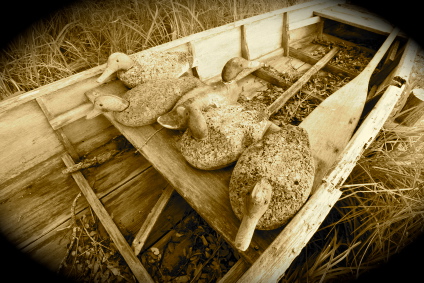 When they finally arrive at the blind they carefully cover the mudboat with cut roseau cane to hide it from the sharp eyes of wary late-season ducks, then clamber into the sunken steel tank. The son begins to make excuses before he needs them. “It’s been a long time since I’ve shot,” he says as he slips three shells into the magazine of the Remington twenty-gauge, the same shotgun his father gave him for his fourteenth birthday. He smiles good-naturedly as he says this, but silently curses himself for feeling the need to account in advance for his inadequacies.
The day is clear and cold and still and there are few ducks flying, but eventually two pintail drakes spot the decoys from somewhere in the stratosphere, break their flight, and drop from the sky. They come in straight over the pond, wings cupped, white breasts shining, preparing to light. They look huge. The old man waits for his son, who rises a little too early and shoots three times. Only then does the father raise his gun. He drops the first bird, then swings on the second as it retreats. It has reached the far edge of the pond by now, apparently out of range, but when he shoots the big bird folds its wings obediently and falls heavily into the water. Two shots, two ducks. Perfect. The younger man’s ears burn with shame.
The father says nothing, just smiles and winks. The son opens his mouth to congratulate him but instead finds himself stumbling through a story he doesn’t want to tell about when he was fifteen and do you remember that time when I was perfect, two-for-two, and you had forgotten the steaks but I got us meat for the pot?
The old man has killed a thousand ducks in his lifetime. He grins at the story and says I don’t doubt it, you used to be a pretty good shot back then, but you know you came up a little early on those pintails, and you can’t just shoot at both of them, you’ve got to pick out one, and it looked like you were shooting a little low.
The younger man starts to respond but, realizing it is pointless, he sinks onto the rough board seat and stares at a rust spot on the wall of the tank. He tries to remember, but it is different now:
I was fifteen years old and I shot two ducks and I am alone in the picture and that’s all there ever was to it. The moment was significant for me only; for him there was no deep spiritual connection, no turning point of newfound admiration for his son. For him it was another hunt. How could I have expected it to have been anything else? He had felt no desperate need to bridge a gap he didn’t know existed between himself and his child. If I had missed my shots that day, what then? Would anything have changed? I would have still been his son, a mystery to him in many ways because he did not know how to know me. But still his son. Perhaps all he required of me on that day–on any day–was that I try.
With this revelation comes a strange sense of release. For the first time he realizes that for twenty-five years he has thought that he must somehow recapture that day when he was perfect, must somehow find a way to earn a love that he thought he had seen only once in his father’s eyes.
But he has never asked that of me and I have required of him something that is beyond his power to give and in doing that I have unfairly condemned us both. He is a man, imperfect as I am. I have demanded from him validation that he could not express and I would not acknowledge. I am forty years old and it is time to put childhood fantasies and unrealistic expectations aside.
Shaking his head, the son says aloud to himself, “I don’t know how I missed it,” referring to his new understanding of the meaning of the meat run.
“It doesn’t matter,” responds the father.
He thinks I’m talking about the pintails, but to correct him would take too many words, too much effort.
When the son turns toward his father the old man looks away into the distance and says, hesitantly, “All of us–we all make mistakes.”
Perhaps he is thinking about this morning, in the kitchen. Perhaps he is more troubled by our relationship than I think. I am not sure what he means, but I want to believe that his words are an attempt at an apology, or at least an explanation.
As the son studies his father’s face in the brightening light, for the first time he actually looks old to him. He is sad that he doesn’t know him.
They return to camp with their two ducks. The father offers them to his son as he has always done, but this time the son says, no, you killed them, you keep them. They pack the boat, clean the camp, and prepare to leave. As he takes a last look around, the son thinks perhaps he will return next year. If he does, he will follow a different path back. He will come with different memories, and he will be the one to rise early to light the heaters and make the coffee.
© 2009 Peter C. Marcantel
 Pete Marcantel–Notes On Life
Wonderful story. Reminds me of my first duck hunting trip with my Dad. I was 10-11 years old , and a girl to boot. But I thought my Dad could walk on water. He adopted me when I was 3 days old. He taught me to hunt and fish and do a lot of other things that would be of help to me in life. Those were sacred times to me. Thanks for reminding me of my good fortune to be selected by such a kind caring man… PJ
Glad you liked the story and that it brought back some good memories for you, PJ. Thanks for taking time to comment.
Excellent! 🙂
Dang, that choked me up. Very good!