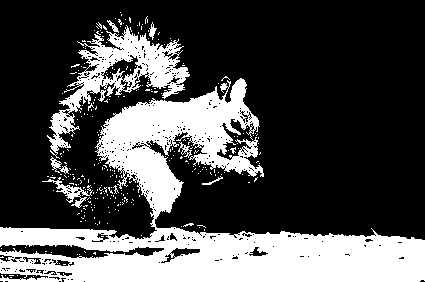
The scream was muffled by the heavy glass patio door and barely reached the bird feeder. The squirrel stopped eating, sat up, and froze, listening. Its tail twitched nervously. Sensing no immediate danger, it dropped its head and resumed its meal.
****
On a bright Saturday morning exactly one week earlier, Howard and Peggy Williams sat on the couch in the den of their comfortable home in Forest Glen subdivision reading the morning paper. Howard glanced through the large picture window toward the back yard.
“That damned squirrel is back,” he said.
“Hmmm?” Peggy did not lift her eyes from the new recipe for delicious low-calorie pecan pie. Howard put down the paper and stepped to the patio door.
“I said that squirrel is back. It’s been here almost every day for the last couple of weeks, eating up all the bird seed.”
His wife leaned to look around him.
“Oh, yes, I’ve seen him. Isn’t he the cutest thing? I love the way they hold their little paws when they eat.”
“I haven’t seen the cardinal around,” said Howard. “Last week I saw the squirrel chase the cardinal away from the feeder.”
“Maybe he migrated,” said Peggy.
“He didn’t migrate. It’s only August, for Pete’s sake, and cardinals don’t migrate, anyway. I’m sure that squirrel chased him off. And if he stays around he’ll chase off the mockingbirds next. I wish I could get rid of him somehow.”
“Now don’t you dare!” cried Peggy in that annoying little-girl voice that she considered endearing. “You know very well that squirrel isn’t bothering your old birds and, besides, I’ve become very fond of him. He’s almost like a pet.”
“That squirrel doesn’t care anything about you. To him, you’re just a meal ticket.”
“Oh, fiddlesticks,” said Peggy, which was her way of ending any argument that she didn’t care to continue. No one in the world said “fiddlesticks” anymore except Howard Williams’ wife.
There had been squirrels in the yard in the past. But these others had come and gone, as Howard reckoned it, in typical squirrel fashion–skulking in like thieves in the night to snatch a few seeds and then disappear (except that they came in the day, but skulking, at whatever hour, is detestable). This one was different, though. This one seemed to have planted his flag in the feeder. He was bold, almost haughty, in defense of his captured territory. Yes, thought Howard, “haughty” is the right word.
Howard wasn’t surprised that his wife couldn’t (or wouldn’t) accept the facts concerning the fickle and malevolent nature of squirrels. He had recently seen a report on the news about a pit bull that had mauled a child, yet the owner insisted that the dog was perfectly harmless. Howard said nothing more, but stood gazing thoughtfully across the patio for quite some time.
Sunday morning found them again in their customary positions in the den. Howard, a bit bleary-eyed after a late-night showing of Dial M for Murder, peered over the edge of his paper at the hairy figure haunting the bird feeder.
“I was thinking,” he said, trying to sound offhand, “about getting a cat.”
His wife was munching noisily at a bowl of fruit and nut cereal.
“I’m sorry dear, what did you say? Something about a hat?”
“I said, ‘I was thinking about getting a cat.’”
“A cat? You know I don’t like animals in the house, Howard.”
“It wouldn’t have to live in the house,” he said nonchalantly. “It could live outside. In the back yard.”
“The back yard? What about your birds? Besides, I thought you didn’t care for cats.”
The birds! Idiot! This would take some careful planning, that was obvious. Peggy was looking at him with a puzzled frown. He had to be more careful.
“Yes, well, just thinking out loud, you know…” His voice trailed off and he rustled the paper noisily. “Anything interesting on the society page today?”
****
At the office on Monday Howard sat in the break room sipping coffee and muttering to himself. There had to be a way, a simple solution he was overlooking.
Howard Williams was a man who liked order in his life. He was punctual, methodical, and conscientious. It was precisely these character traits that led him into his chosen profession as an accountant–numbers were something you could organize and rely on to stay organized. Thus, when Peggy Williams finally persuaded her husband to sell their practical condominium in downtown Houston and move to the suburbs, Howard had attacked his new lifestyle with the same attention to detail. For two years he planned and executed his landscaping goals, choosing carefully and placing each mimosa tree, azalea bush, and jasmine vine just so, to achieve the proper effect. He was particularly pleased when the birds discovered the feeder he erected in the back yard. He had always loved birds–an appreciation nurtured in him by his mother–and to see them crowded near his patio was the final stroke in his meticulously painted suburban masterpiece. But now this gray smudge…
Ed Cole walked into the room and poked his head into the refrigerator before extracting a soft drink.
“What’s up, Howard? You look distracted. Is the Campbell audit giving you fits?”
“No, no. It’s got nothing to do with work. It’s just–” He paused and looked at Ed. Perhaps this is just what he needed. If only he could talk about this with someone who understood; get it off his chest. By talking it out, maybe he could see the answer that seemed to elude him. Maybe another point of view was just the thing.
Ed sat at the table next to him, studying Howard’s worried face.
“Hey, this looks pretty heavy. What’s bothering you? Want to talk?”
“Well, you see,” Howard began, unconsciously covering his face with his hand as he often did when he was deep in thought, “there’s this squirrel–”
“A girl? Why Howard, you old devil!” whispered Ed conspiratorially.
“Not a girl. A squirrel.”
“A squirrel?”
“Yes, and it’s eating all my bird seed and I’m convinced that it’s run off the cardinal, and there’s a good chance it could run off the mockingbirds next–”
“Uh-huh,” said Ed, rising. “Well, I see your problem. Listen, I’ve been meaning to talk to you about the Sacred Heart Church account. We did that work four months ago and we haven’t seen a dime yet. You know your problem, Howard? You’re too nice. Do you know what old Father Martin is saying to his secretary right now? He’s saying, ‘Put off the payment to Williams and Cole until next month. Good old Howard won’t mind. Make an extra payment on my Cadillac instead.’ That’s what he’s telling her. You’re a good accountant, partner, but you’ve got to toughen up when it comes to taking care of what’s yours. Can’t you write them a letter or something?”
Howard watched Ed disappear through the doorway. He sat for a moment more, then moved to the sink to wash his cup. Ed didn’t understand, of course. How could he? He didn’t know what Howard knew, had never seen those brilliant red feathers; he had probably never been bitten by an animal in his life. This was Howard’s yard and Howard’s wife, and Howard’s problem, and his alone. Perhaps it was better this way.
Take care of what’s yours. What was his anymore, anyway? Certainly not his bank account. He had been a comfortable bachelor for thirty-four years of his life before meeting Peggy. Since their marriage eight years ago she and her credit cards had nibbled away at his savings, seemingly oblivious to concepts like economic downturns and negative cash flow and deferred gratification. His circle of friends had steadily diminished as he worked harder to keep up with her spending habits and accommodate her own social agenda. Then this house idea. She had persisted with it until he finally gave in and agreed to take on the fat mortgage and homeowner expenses life in suburbia offered. But he had adjusted. He always adjusted.
That night on the news a reporter was interviewing a policeman in front of a large house in an affluent neighborhood. The forty-five-year-old investment banker who lived there had bludgeoned his wife to death with a claw hammer that afternoon. All the neighbors said what a nice man he was; he always bought ice cream for the kids on the block when the ice cream truck came through. The policeman was saying, “You can never tell what a person is capable of doing…”
****
His parents had squirrels in their yard when Howard was a child. There was one in particular, a large fox squirrel, that Howard had spent weeks taming as a boy of twelve. Each day after school, the squirrel appeared on the bottom limb of the large oak tree outside the dining room window and Howard carried sunflower seeds to it, approaching a little closer every time, until that exciting day when the squirrel actually took a seed from his hand before scurrying back up the gray bark. After that progress was faster. Before long Howard sat with his back against the trunk of the tree and the squirrel sat on his shoulder, eating from the palm of his hand.
One day, for no reason at all, the squirrel bit him–hard–on the finger. Howard yelped and jerked his hand away, sunflower seed husks scattering in the autumn wind like dead dreams, and the squirrel rushed to the bottom branch of the oak and chattered furiously at him. Howard felt angry and betrayed after all he’d done to befriend this little creature, and sucked his throbbing finger with tears welling in his eyes. He learned a valuable lesson that day. He learned you can never trust a squirrel.
****
Howard dropped the ten-pound sack of sunflower seeds on the counter. He could have bought the same thing cheaper at the big discount store two blocks down, but he enjoyed going into the feed store. The rich smell of oats mingled with leather reminded him of his grandpa’s barn, of haystacks and carefree summer nights under the stars with his brothers. Days of innocence, he thought as a wry smile curled his lip, before twenty years as a C.P.A. hardened a man into the kind who would do whatever it takes to survive. He came to the feed store for memories, sometimes, it was true, but today he was not looking for nostalgia. Today he needed information. He eyed a large rat trap hanging on the back wall as he produced his wallet.
“Tell me,” he said casually. “What would a person do if he had pests in his yard? How would he go about getting rid of them?”
The old man rummaged in the register drawer for change.
“What kind of pests? Like fleas?”
“No, no. I mean big pests. Like squirrels, for instance.”
The man handed Howard his receipt and reached under the counter for a bag.
“Kinda funny,” he said. “Don’t guess I ever heard anybody ’round here refer to squirrels as ‘pests’ before. You got a problem with squirrels?”
“Me? No, not really. I was just wondering…you know, they can be kind of pesky, can’t they? And I understand they can carry diseases.”
“That right? Well, I guess if you really wanted to get rid of ’em you could try to poison ’em. We got rat poison. But that seems kind of mean, don’t it? Poisoning a squirrel? Besides, you could wind up killing an innocent bystander, so to speak. A neighbor’s cat or something.”
“That would be bad, wouldn’t it?” Howard agreed.
“ ’Course, what you should do is trap ’em,” said the storekeeper, pointing to the small cage on the floor behind Howard. “With something like that. Then you can haul the little fellas off somewheres else without hurting ’em. Lots of people use those for skunks and such.”
Howard studied the little wire box–$59.95!–for a few seconds, his mind playing the scenario on fast forward. Perhaps if he put it near the air-conditioning unit Peggy wouldn’t notice it. But there was really no place to get it completely out of sight.
“No, that wouldn’t work,” he mumbled. “She would see it.”
“Of course she would see it. That’s the whole idea. But if you leave it there a while, she’ll get used to it, then, with the right bait, she’ll crawl right in and bang! there you’ve got her.”
Howard stared at the man in confusion for a moment.
“I didn’t mean the squirrel. I meant my wife.”
“Your wife?”
“Never mind.” Howard picked up his bag from the counter and started out of the store.
“Don’t know why anybody’d want to get rid of squirrels, anyhow,” said the old man to himself, but loudly enough so Howard could hear it over the jingle of the little bell at the top of the door.
****
Howard had a shotgun in the hall closet. It had been a long time since he had used it, but he was sure it would still work if he bought some fresh shells. His father gave it to him when he was a boy, and he became a pretty good shot by the time he was fifteen. He and his dad made duck hunting trips together into the marshes and Howard enjoyed that until one day when he was alone in the blind and he wounded a duck that fell on the other side of the pond. He watched the little teal swim around in circles for an hour, dying slowly and pitifully, and after that Howard couldn’t ever bring himself to shoot at another duck. He always made some excuse when his father invited him, and eventually his father stopped asking. He had never hunted since, but he kept the gun because he thought someday he might need it.
He judged the distance from the patio door to the bird feeder. It was only about ten yards, an easy shot with a shotgun. The squirrel was sitting there now, going through seeds like it hadn’t eaten in a week even though he’d seen it there earlier this morning gorging itself. If he had the gun with him, he could settle this now. Of course, the blast would blow the terra cotta bird feeder all to pieces, too, which was a shame because he liked the way it looked. It was really a bird bath–a large, flat bowl resting on a two-foot-tall stand–but they had always used it for seeds. It had cost seventy-five dollars. Still, it could be replaced. Howard tried to remember the proper technique: raise the gun and level it. Hold the stock tightly against the shoulder, put the sighting bead just below the target to allow for recoil, and gently…squeeze…the…trigger…
Peggy appeared behind him and playfully tugged at his ear.
“A penny for your thoughts!”
He managed a weak smile.
“Oh, you’re watching the squirrel again. Isn’t he cute? Look at that notch on his ear. How do you think he got it? I bet he got in a little squirrel fight, poor thing. Well, I’m glad to see that you two have made up, anyway.”
When he turned to look at her, he was startled for a moment. He had never really noticed how pointy her little face was, and the strange way she held her hands up in front of her.
****
How do you get rid of a body? You could bury it, but then you risked somebody discovering where the ground was disturbed. Maybe you could wrap it in a trash bag and drop it in a nearby dumpster…
Howard picked up a piece of fried chicken and began to gnaw on it. Peggy was chattering on and on about her upcoming bridge party and listing all the things she expected him to do to prepare the house. She was getting on his nerves. Why did she have to make things so complicated? It was just a stupid card game. It was just a stupid squirrel. Why did this have to be so complicated?
He stared at the bone in his fingers and stopped chewing. He recalled a scene from the movie Fried Green Tomatoes. In it, two women who have killed a man cook the body and serve it in a meal to the unwitting sheriff to get rid of the evidence. “Best ribs I’ve ever tasted.” He made a mental note to check the cookbooks for a recipe for squirrel gumbo.
****
It was 5:45 on Wednesday evening when Howard rounded the corner into his subdivision and started down the tree-lined street to his home. He was listening to All Things Considered on the radio and deeply absorbed in the story about the latest increase in deficit spending by the current administration when fate presented the solution to his problem. A gray streak flashed across his front lawn and stopped suddenly in the middle of the road. The squirrel raised itself on its hind legs and looked around. Howard slowed the car automatically and looked at the small figure, and, in a moment of time, everything was perfectly clear. It would look like an accident. It would be fast and efficient. There was no way Peggy could connect him to it. Perfect. He glanced in the mirror at the empty street behind him, then quickly scanned the quiet lawns that surrounded his. He slammed down the accelerator and the car lurched forward. At the last second the squirrel bolted for the curb, but a slight adjustment of the steering wheel was all that was necessary. There was a sickening thud as the car shot down the street and Howard didn’t dare check his mirror. He slowed and circled the block, his hands trembling violently as he made the last turn that brought him home.
You can never tell what a person is capable of doing…You can never tell what a person…You can never tell…Never tell…
The gray lump lay motionless in the street. He turned into his drive, hurried into his house, and did not sit down until he had poured himself a stiff drink.
****
Howard lay in his bed staring into the darkness. He could not close his eyes without seeing the little creature propped on its haunches in the middle of the road, and the dull thud still reverberated in the pit of his stomach. Tomorrow Peggy would go out for some errand–probably shopping, what else did she do?–and she would see the squirrel in the road. How many tires would have marked it by then? The longer he imagined the scene the more gruesome it became.
They are rodents, he told himself. He pictured the ugly little rat-like head and the large, dangerous incisors closing on his finger. He thought of the cardinal, with its brilliant red coat topped by that striking black mask, fleeing for its life from the attacking beast. Each time he tried to meditate on these things, Disney images of singing squirrels danced in to replace them.
He glanced at the clock. Twelve-fifteen. He rolled out of bed and lifted his robe from the night stand.
“Whunyoudoon?” mumbled his wife.
“I have to get some water.”
He quietly slipped downstairs and into the garage. Taking the shovel, he hurried across the yard toward the pale blue circle cast by the mercury vapor light above the street.
****
The next morning Howard left early for the office, wanting to avoid the empty bird feeder and the possible probing questions of his wife. He was jumpy all day, and uncharacteristically short with his secretary. When Ed passed him in the hall right after lunch and jokingly asked, “Hey, Howard, how’s the squirrel?” he broke into a sweat and had to spend ten minutes in the men’s room before he could stop trembling.
That night, when supper was finished and Peggy had still not mentioned the squirrel’s absence, he began to feel, somewhat tentatively, a return of his self-control.
By Saturday morning Howard was practically himself again. Peggy was already in the den with the morning paper when he entered carrying his coffee. The sun streamed through the patio door, bathing the room in its cheery warmth.
“Good morning, darling,” he chirped. “I hope you slept well last night. All set for your bridge game this afternoon?”
“My, aren’t we bright-eyed and bushy-tailed this morning! It’s good to see you coming out of that horrible funk that’s possessed you for the last few days.”
“Sorry if I’ve been testy lately. Big audit going on. What’s that you’re nibbling on?”
“Rice cake. Would you like one?”
“No thanks.” He settled on the couch and picked up the front page. “Think I’ll scramble myself some eggs in a little while.”
“Oh look!” said Peggy. “Our little friend is back.”
Howard smiled. Of course the cardinal came back. The mockingbirds would stay, also, and thus his vindication would be complete. There are circumstances, rare ones, when extreme measures must be taken; a man must be tough in taking care of what is his, and it is not necessary for all to know or approve…He lowered his paper and looked expectantly across the patio.
Resting in the center of the feeder was a hunched gray figure. At first Howard did not trust his eyes. He blinked once, twice, transfixed by the apparition. A scene from an Edgar Allan Poe story flashed through his mind: a heart beating, beating, beating in the ears of the murderer, though no one else could hear.
“That isn’t the same one,” he finally said.
“Sure it is,” said Peggy.
“I’m telling you, that can’t be the same one.”
“Yes, it is! Look at that little notch on his left ear. I’m so glad he came back. I haven’t seen him for a couple of days…” Howard turned to stare at his wife. Mrs. Nutkin. “…so I checked the feeder and it was empty…” She twitched and jerked excitedly. “…so this morning I…” Who is buried in the garden? “…put out some fresh sunflower seeds…” Innocent bystander. “…to see if he would come back…” You can never trust a squirrel. “…and I’m so glad…” Who is in the garden? “…Howard, are you all right?…” You can never tell what a person is capable of doing. “…what on earth…?” You can never tell what a person is capable of doing. “…Howard…?”
The scream was muffled by the heavy glass patio door and barely reached the bird feeder. The squirrel stopped eating, sat up, and froze, listening. Its tail twitched nervously. Sensing no immediate danger, it dropped its head and resumed its meal.
© 2009 Peter C. Marcantel
 Pete Marcantel–Notes On Life